From Broadway to Fairvu: How Sasha mereu Is Revolutionizing Music Industry Revenue Streams


 RSS Feed
Ever wonder what happens when theatrical magic collides with punk rock energy? Sasha Mereu embodies this fascinating intersection as the self-styled "punk rock Willy Wonka" - and he's on a mission to transform how musicians earn a living.
Sasha takes us on a captivating journey through his remarkable career spanning over 1,000 stages worldwide, including a Broadway run in 2016 with "The Illusionists: Turn of the Century" - which became Broadway's highest-grossing magic show. His performances blend theatrical elements with musical prowess, creating an electric, unpredictable energy that keeps audiences on the edge of their seats. Rather than avoiding eye contact like many musicians, Sasha dives into crowds, creating personal connections and sometimes conjuring balloon animals out of thin air.
Beyond his performances, Sasha delivers a compelling analysis of how the music industry fundamentally changed with Napster and subsequent streaming platforms. The traditional model of recording albums, touring, and selling physical copies has collapsed, leaving most musicians struggling to earn living wages. His response? Co-founding Fairvu, a benefit corporation building a digital platform that enables musicians to livestream concerts with virtual ticket sales, store media on-demand, and sell merchandise - all while keeping 90% of their earnings.
What makes Fairview unique isn't just its artist-friendly economics but its structure as a benefit corporation balancing profit with community benefits and complete transparency. Rather than seeking large investors, they're taking a grassroots approach by asking musicians to contribute just $5 each to build the platform together.
Whether you're a musician feeling the squeeze of streaming economics, a fan wanting to better support artists you love, or simply fascinated by creative entrepreneurs tackling industry-wide challenges - Sasha's insights offer a refreshing perspective on creating sustainable artistic careers in the digital age. Check out fairvu.net to support their mission and help reshape the music industry's future.
Want to be a guest on Living the Dream with Curveball? Send Curtis Jackson a message on PodMatch, here: https://www.podmatch.com/hostdetailpreview/1628631536976x919760049303001600
0:00 Welcome to the Living the Dream Podcast with Curveball, if you believe you can achieve. Welcome to the Living the Dream with Curveball Podcast, a show where I interview guests that teach, motivate and inspire. I interview guests that teach, motivate and inspire. Today, I am joined by author, artist, writer and musician, sasha Merrow. Sasha has performed around the world in over 1,000 stages, including a run on Broadway in 2016,.
0:53 Sasha labels his self the self-style punk rock Willy Wonka. So we're going to be talking to him about his amazing performances and everything that he's up to and what he means by being that self-style punk rock Willy Wonka. So, sasha, thank you so much for joining me. Absolutely my pleasure. Thanks for having me. Why don't you start off by telling everybody a little bit about yourself? Certainly Well. I am currently located in Portland, oregon, in the Pacific Northwest, and you gave an amazing introduction in terms of the sorts of things that I've done. I've lived a lot of life and I'm excited to live a bunch more.
1:33 My current project deals with music, although I'm an open book and able to talk to you about anything and everything you'd like to know about creativity and incorporating that into your life and what the various careers in the arts have been and the state of the music industry currently and what's happening with musicians. And my current project, which is called Fair View. That is, fair VU, where we are looking at building a digital platform which will enable musicians to be able to create new revenue streams and survive a little bit better than they are now in the digital streaming world that we have created.
2:15 Well, being an artist myself, that would be great. One thing I did forget to mention in the intro is that you talk about how you are the chaos between the intersection of music and theater. Tell us what you mean by that. Absolutely so. You know, theater is a huge part of who I am and my background. One of my bachelor's degrees is in theater performance and I have been a musician for 25 years and professionally in the industry for about 20. And, interestingly enough, very rarely have those two interests intersected together.
2:55 I ended up doing a musical last October. I played Judge Turpin in Sweeney Todd here in Portland and that was the first musical that I've done since Greece, when I was 18 years old in high school as a senior. Except that the theater part of my life and specifically I've spent the last two decades doing magic and stage illusion as part of the theater thing as well. I've been a magician.
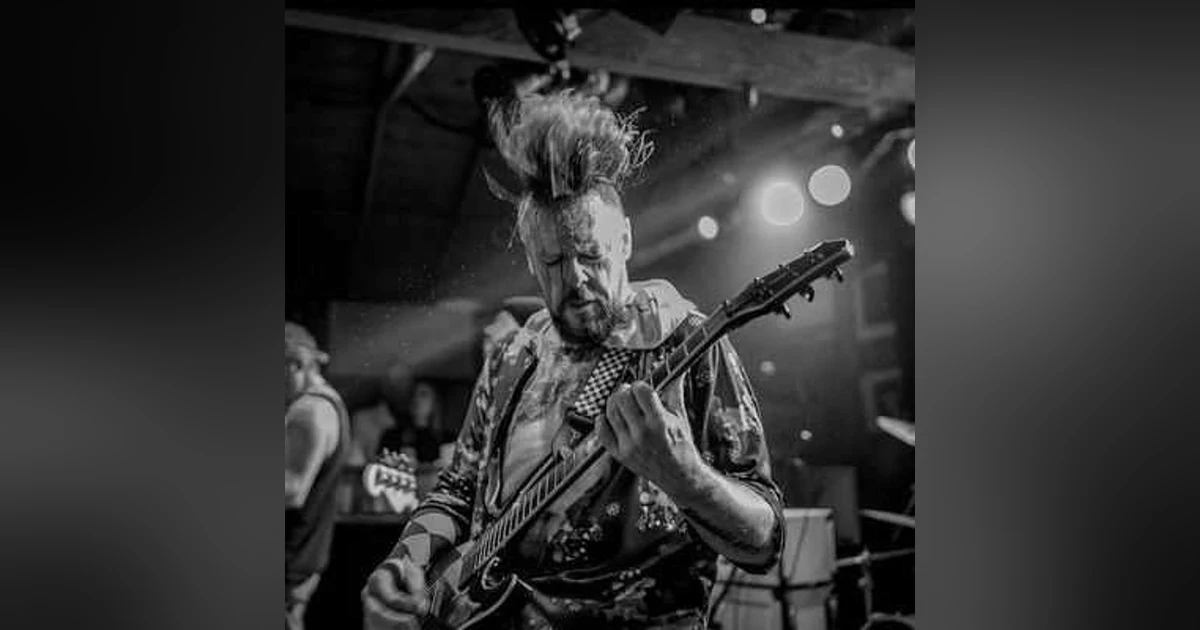
4:05 The theater aspect of my life has informed my performance and the way that I look at doing music actually, and so creating chaos at the intersection of theater and music together is pretty much every time I step on stage, it's not one or the other, it's always there with me, and that creates for a unique and fun experience, not just for me, but hopefully for the audiences that I get to perform for. Okay, well, enlighten the listeners on what you mean by the self-style punk rock. Willy Wonka, certainly so. I currently play guitar for a punk rock band called United Defiance and we are based out of the San Francisco California Bay area, the East Bay, like around Oakland, walnut Creek, places like that. Obviously, I don't live there, so I don't rehearse with that band. When it comes time for me to play, I show up ready to go rehearsed, with all of my parts and all of my vocal harmonies good to go and my solos and all of that. And when we hit stage it's the first time that we've all played together since the last gig that we had, and sometimes that's weeks, sometimes that's months.
4:50 So it's interesting. But I've been with this band for the last seven years and playing in and out of punk rock bands really since I was about 14. And Willy Wonka is such an image for me in terms of a character because he so Roald Dahl wrote the original book Charlie and the Chocolate Factory, and the character of Willy Wonka is this kind of crazy inventor who quite obviously plays, you know, marches to the rhythm of his own drum. And I was deeply touched by the original movie Willy Wonka and the Chocolate Factory. That had Gene Wilder and I loved it as a kid and there was a scene in it the first time that Willy Wonka is actually seen by the camera.
5:39 He's coming out of the candy factory and he's limping and he has a cane and looks very old and feeble and infirm. And then he falls forward and ends up into a roll and jumps out of it and everyone bursts into applause. And in an interview Gene Wilder was talking about how that particular instance that was something he came up with and added to the film. That was not in the original script. In fact that was the condition for him to do the movie. And the director said let me, let me get this straight like, if we don't let you do this scene, you're not going to do the film. And he said that's exactly correct, because everything that that character does now, after that initial introduction, the audience doesn't know whether or not to trust him and there's a very electric, interesting, curious energy that goes along with that and that is sort of the summit, the apex, that I aspire to when I perform.
6:36 I'm not one of those shoegazing musicians who sort of does not acknowledge the audience or looks above their heads. I love to make eye contact with each and every one. I sing to people within the first two songs. Usually I am down in the audience, high-fiving everyone and welcoming them and singing to them, and they never exactly know what to expect. Sometimes there's props and balloon animals appear out of nowhere. Sometimes the costumes are all over the place and so it's very chaotic. But it's a high level of art that I like to put into the performance that we're putting together. It reminds me of Willy Wonka, and that is a fun image for me to sort of embody on stage.
7:21 That would be my onstage character to sort of embody on stage. That would be my onstage character, okay, well, speaking of onstage, you performed in over 1,000 stages across the world, including that run on Broadway in 2016. So kind of tell us about that and how that felt. Absolutely so. You know, broadway is the. That's the height of every. Every actor's dream, of every actor's career is is doing a run there. Um, I was incredibly fortunate when I was, when I was quite a bit younger, my dad, uh, showed up one afternoon, you know from work, and I was playing basketball in the driveway and he said hey, do you want to go and see a magic show? And I have loved magic since I was a kid and I was like, absolutely, let's go check it out.
8:06 And the show that we went and saw, it was down in Reno, nevada. I grew up around Lake Tahoe, way up in the mountains there, near the ski resorts, and so we went down to Reno and the show was called Carnival of Wonders and it featured three magicians Mark Kalin, ginger Kalin, so a married team and a guy named Jeff Hobson, and they had created a carnival with all of the different sections of the carnival the Tunnel of Love, the House of Horrors, the Illusionarium, all of that stuff, but with magic and stage illusion. And it absolutely blew my mind, illusion, and it absolutely blew my mind.
8:47 And I remember turning to my mom at the end of the show and one telling her like I had no idea humans were capable of doing something like that. Uh and two I said one day I'm gonna work with them, and uh, sure enough, I've been working with uh mark and ginger kalen for the last 20 years. We've toured the world together and it was under that partnership that I was able to go and do the run on Broadway. So the show that we did was called the Illusionists Turn of the Century, and it was essentially a recreation of the kind of magic show that you could have seen around about 1903, during what is called the golden age of magic, have seen around about 1903, during what is called the golden age of magic, which is when all of the big, famous performers obviously harry houdini, but also thurston and keller and chung ling su, alexander herman that all of those very famous performers were were active, and so the show itself and so the show itself it was done in two acts and it featured performers, all of which who had between it went on to be the highest grossing magic show in Broadway history.
10:10 Actually, it was an amazing time, and for the 2016 holiday season, in between Thanksgiving and New Year's Day, I got to live and work in New York City. I lived just next to Hell's Kitchen on 43rd and 8th and you know, times Square was essentially my office. We were at the Palace Theater and it was an absolutely insane and wonderful time in my life being able to engage in magic. Houdini had performed in that theater himself, you know, 90 years prior to that, had performed in that theater himself, you know, 90 years prior to that. It was really surreal and wonderful and I'm deeply grateful for having had the experience and you know, everything that got me there is attention to detail and being passionate about what I did.
10:58 Well, congratulations on that. Thank you, sir. I've come to a point in my life so I'm 43 now and so I'm old enough to have seen the music industry change a couple of different times but fundamentally it was Napster that changed everything, when we started to go peer-to-peer and doing file sharing and you could listen to music for free without purchasing it for free, without purchasing it.
11:53 And it was even before that where you couldn't purchase songs just by themselves unless it was a single that had been officially released Back in the day. You had to buy the record, you had to buy the CD, you had to buy the cassette and you would listen for the song that you liked, but you had access to the entire concept of what that artist had put out as a complete piece of art. And Napster changed everything. And as soon as that got taken down, it was immediately replaced by Kazaa and by LimeWire, and it's like we had let the genie out of the bottle and now people were able to listen to just the songs that they liked and ignore the rest of everything, and then they didn't have to pay for it. And this was really a turning point for the music industry, because where we are now is that record sales, essentially, are a thing of the past.
12:41 People do still buy records, but it is not something that a professional musician can rely on to be able to pay the bills. Professional musician can rely on to be able to pay the bills it used to be. You would write the record, you would record it and then you would go out on tour and you would sell copies of it and you would tour and play live in support of that particular record and you'd sell merch and while you were out on tour you would write some more songs and write down sort of the experiences of what's happening and process that and by the time you came back in off the road you had some ideas at least of what the next record was going to look like and you would put those songs together and the cycle continued. And now, because people are not buying records in the numbers anywhere even close to what they used to, because they're getting everything for free on Spotify or Apple Music or Google used to, because they're getting everything for free on Spotify or Apple Music or Google any of those particular platforms you can only make money really by touring and post-COVID the cost of touring has absolutely skyrocketed and is preventing a lot of musical acts from even engaging in that.
13:45 Certainly, when it comes to doing international contracts, lots of American artists simply can't afford the visas and everything that it takes now to go over to Europe, and same with European artists trying to come over here. So, with that sort of being the backstory, my partner, my co founder his name is Telson. He's a middle school friend of mine. We met in middle school band of all places, and have stayed in touch this whole time. He came to me about a year ago and he was like hey, dude, I've got this idea. We both have been in the industry for about 20 years. He is an audio engineer and a technician and amazing at what he does.
14:25 He's worked with a lot of different people. He does a lot of live events and production and he was noticing the same tendencies and the same struggles that musicians have been going through in trying to make a living doing music in something that has the audacity now to call itself the music industry, when music is almost like a secondary, takes a backseat to what's actually happening, because all of the money is certainly not going to the artists. So we founded a company, a benefit corporation, in California called Fairview. That is Fairview and we are proposing our solution to the situation currently, and so we are trying to build a digital platform that is going to essentially offer three services, and we are not reinventing the wheel.
15:18 This is nothing new and crazy revolutionary, except for the fact that we are combining them all together into one united platform. So the idea is that you, as a band or an artist, you are going to go and play a show somewhere, and let's say that you're playing in Los Angeles and you've got a bunch of fans who are in Chicago and you know the Chicago fans are not going to travel to Los Angeles to be able to see you, even though they love and adore your music. Well, using our platform, you will be able to throw a video camera on your live performance and then, through our platform, live stream that concert back to any of your fans anywhere in the world, essentially and charge digital tickets to see that particular stream, and we are not going to set prices as to what we think your music is worth.
16:11 This is just going to be between you and your fans and, you know, even it doesn't have to be a huge, crazy price. It could be something fairly low, even if it's just a dollar, if you have an extra 50 people who are able to virtually attend that show in Los Angeles from Chicago or elsewhere, that's 50 bucks. That would be going directly to the band instead of to a middleman, a distributor, a record label, something like that who is going to be taking 85 to 90% of what you're doing. We are going to be letting you keep 90% or thereabouts of what's going on and take a small fee for that to be able to run the company thereabouts of what's going on and, you know, take a small, a small fee for that to be able to run the company.
16:51 But essentially, we want to create connections that are deep and meaningful in between bands and their fans and allow musicians to monetize what they are already doing directly to their fan base for support. We're also going to offer media on demand for storage for previous shows and there's going to be an e-commerce storefront which will allow you to sell merchandise as well. Okay, well, I heard you mention Benefit Corporation. Explain to the listeners what a Benefit Corporation is. Yeah, absolutely. It's interesting hearing that word corporation. A lot of people, myself included, have almost a knee-jerk reaction to that, and that's part of the problem is corporate greed in the music industry, with Ticketmaster, with Live Nation, with Spotify, with all of these big names that are huge corporations that they're taking the profits away from artists.
17:43 Corporation is a little bit different and this is something that is fairly new in terms of the business scene. My business partner, Telson, is much more well-versed in the business side of this, but I've got this and I'll take you through. So a benefit corporation is required by law to announce their what are called benefit purposes and they have to balance profit, which essentially a corporation is designed just to create profit. They have a board and the board, you know, answers to the shareholders and the shareholders just get more and more money. It is required to balance profit with being a direct benefit and support to its community through these particular benefit purposes.
18:32 So in our case, we identified six things that we want to do and at the end of every year, we need to come together and have a meeting and we need to prove on paper that we are fulfilling these benefit purposes, which are to uh, to aid, um and benefit society as a whole and our, our particular communities, and so it's a. It's a decent balance to do that. Uh, Patagonia is a is another example of um, a benefit corporation. They, uh, they are helping out the environment and their community while they are also doing doing business and making a profit, and so it's a different kind of a way. Corporations don't need to be these sort of evil, faceless things.
19:14 We are all about transparency and integrity in doing so. All of our meetings are live streamed, publicly available, so that you can see exactly where money is going and what's happening, and it's not just sort of disappearing up, you know, up someone's sleeve into pockets or offshore funds or whatever it is. So for people wanting to support Fairview and everything that you and your company are up to, how can they do that? Amazing question. Thank you for the setup on that. So we are currently in our fundraising stage.
19:55 We've got the company up and running. We have a team of full stack developers and software people who are standing by. We just need to find the funding to be able to build the software to make this thing happen. It's going to take us around a million dollars to get to beta, maybe slightly more. And so how we are doing this initially we had put together a whole pitch deck and we were going to go to a couple of investors and say, hey, if four of you can give us half a million dollars, that would be helpful and we can get this thing put together. And we realized that because both Telson and I are musicians, we've put in our time in the music industry, in the trenches with everyone else touring and playing to half empty bars, and you know you know paying your dues that we have decided that this is really more of a grassroots movement.
20:42 So we are trying to get in front of as many musicians and independent artists as we can, and if we can get half a million musicians to give us five bucks a piece, this thing would be built and ready to rock within the space of three months. So we have a website, and that is fairviewnet, and it outlines everything that you need to know about who we are. There's a call to action video. We state what the problem is, we state what the solution is, and we are currently running an online store. We've got three virtual products that you can purchase to help us physically build this, and every purchase goes right to helping us build this particular platform and keep the company running.
21:28 We are on all of the socials Facebook, instagram, tiktok, all of that stuff and we're doing interviews. I'm traveling around the country doing stuff both in person and virtually. I'm interviewing bands and musicians about what their life is like doing this professionally and what would make their lives better and what their experiences have been in the music industry, because really, we are all of us stronger together and we are excited to build something that is going to be amazing and we're going to need our community to be able to do that. Well, sounds like you're up to a lot, but tell us about any other upcoming things that you're up to that the listeners need to be aware of and do something good for my health, whether it's exercises, a plank or squats, or I run or do a cold plunge or whatever it is and I do that while listening to music and sort of reviewing what I hear and giving bands that are underexposed some exposure and some love and try to drive some traffic over to their site, and we're just trying to make sure that people love the artists that they that they support and they support the artists that they love.
22:55 So that's, uh, that's, that's what's going on in terms of Fairview, and I don't know if you're talking about uh in in addition to that, with me as a, as a creative outside of the context of that, or not. Um, but that's what you know, what you're up to as well. Well, okay, I'll, uh, uh, I'll tell you what there's. There's lots of stuff going on. Actually, I'm in the process of writing a Ted talk and, uh, trying to get that shopped out. This is, um, essentially, uh, this is the art of how not to be bored and, uh, looking forward towards embracing a life starting at 40 is the uh, uh the subject of my talk, so that will be something forthcoming. I also do a podcast myself, but it's not this sort of a format, it's more like a radio drama.
23:39 So I'm a writer, a writer of short stories and of plays, and I have started a podcast called Magoosh Medrick, vampire Hunter, and this is a. It's like an old fashioned radio drama where you have the story and it's narrated, but all of the voices and dialogue are done through voice acting A lot of them with me. Sometimes I hire actors to do that. All of the sound effects are there. There's music. Danny, the drummer for United Defiance, actually is an incredible musician in his own right outside of the context of that band, and he has composed the theme and I work with him whenever I need music done for that.
24:21 And this particular show, magoosh Medrek it's a dark comedy about a vampire hunter who is essentially horrible at his job but incredibly lucky, almost like an Inspector Clouseau type person. So he will walk into a town and it's filled with vampires or werewolves or ghosts or demons or imps. You know, it's kind of a gothy type thing with like Monster of the Week vibes and he'll sort of mouth off to everybody and he has this outrageous German accent and is just sort of over the. He essentially closes his eyes and then everything goes wrong.
25:13 But it goes wrong in exactly the proper sequence, so that when he opens his eyes everybody else is dead except for him. And, um, he's good to do that. It's a. Um, I will say it's a. It's a fairly violent show but done very tongue-in-cheek, uh, sort of like Monty Python and the Black Knight, that kind of over the top sort of violence, and it's a lot of fun. It's a lot of quirky, strange writing. So he's on YouTube and Spotify as well and I am always doing magic and out and about doing that. I've got a couple projects coming up. I will be appearing in a couple of public shows down at the United Theater on Broadway in downtown Los Angeles and that's going to be the weekend of May 2nd, 3rd and 4th.
26:05 I'm headed down there to do the Magic Castle Awards, and then we're going to do a couple shows for the public, and then I will be at Six Flags in St Louis, and then that'll be in May, and then New Jersey come July and essentially I'm going to be installing an illusion show for an illusionist named Brad Ross Young, young, young, he's my age, but he looks way better than I do. He's an amazing magician in his own right. He's got his show that is going to do a month residency at two different Six Flags parks St Louis and New Jersey, the Grand Adventure there and so I'll be taking care of doing that installing the show and teaching the crew.
26:47 And so I'll be taking care of doing that installing the show and teaching the crew how to build illusions, how to maintain them, how to how to do pyro safely and, you know, set spikes on fire and not burn the house down, and all of that. And so that's that. And then I'm also getting married in October, so that's going to be amazing and I'm very excited for that well, congratulations on that. Thank you, sir. Throw out your website and close us out with some final thoughts. Maybe, if that was something I forgot to talk about that you would like to touch on, or any final thoughts you have for the listeners. Absolutely no. Thank you very much. This has been an amazing conversation. Thank you for letting me just talk and go for it and guiding us along the way.
27:30 If you for letting me just talk and go for it and guiding us along the way. If you are interested in supporting Fairview and what we are up to the website is fairviewnet Go and check it out. We have our online store. There are three digital products that you can purchase. We have what's called a virtual engraving. So when we launch our platform, the name of the platform is not Fairview. That's the company. We're keeping it under wraps for the time being, but if you buy a virtual engraving, we are going to add your name to the logo of what this platform is going to be and the logo, the art, is literally going to be all of the names of everyone who has supported us.
28:10 Through that, you will help us physically to build this platform. We are also selling digital badges that you can throw onto your profile and sort of like a digital battle vest, if you know what that is that kind of vest in denim or leather with the sleeves cut off that's covered in patches. When you go to rock and metal shows of all the bands that people like. So you'll be starting your virtual battle vest with Fairview and then we are doing pre-sale ticket bundles for once the platform has launched. These virtual tickets are good for any artist who is going to be on there for a full two years until after we've launched. There's a bunch of different tiers, depending upon how much you feel that you can support. The lowest is $5.
28:50 We would love to be able to help build this thing and even if you can't swing five bucks, we totally get it, because things are very expensive these days. You can sign up for our mailing list and we'll give you five virtual tickets for free, just for supporting that and becoming part of our community. So have a look at that. Please check out our videos on YouTube, and I know that you hear this all the time. You can like, subscribe, follow us on the various socials and we will see you out there. And if you're a band or a musician, I would love to interview you. So hit us up, get in touch with us sashaatfairviewnet. That's my email and I'd love to chat with you and spread the word and go from there and hear about what you guys are up to.
29:35 And, curtis, thank you so much for your work. You run a great show here. Well, I appreciate it and I definitely need to hit you up for one of those interviews and listeners. You're going to hear this from me again. Like subscribe. Share this episode to as many people as possible, especially anybody who can support Fairview or any other musicians out there. Check us out on your favorite podcast platform. Visit wwwcurveball337.com for more information on the Living the Dream with Curveball podcast. Thank you for supporting the show and, sasha, thank you for all that you're doing for musicians and thank you for joining me.
30:16 Absolutely my pleasure. Thanks so much. Have a good one. For more information on the Living the Dream with Curveball podcast, visit wwwcurveball337.com. Until next time, keep living the dream.